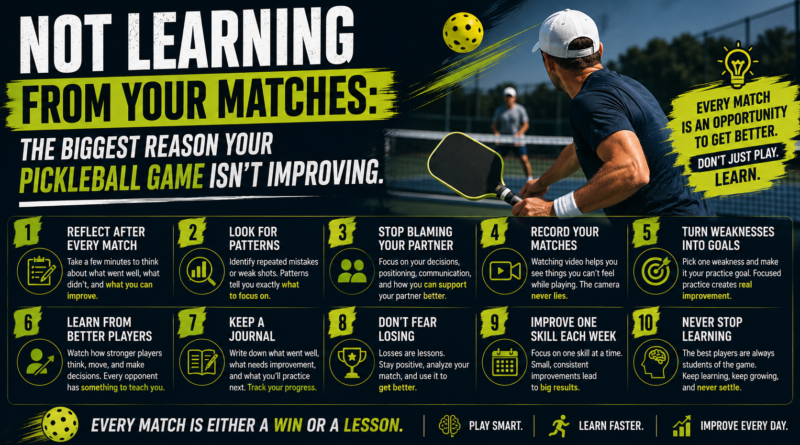
Not Learning From Your Matches: The Biggest Reason Your Pickleball Game Isn’t Improving
Not Learning From Your Matches: The Biggest Reason Your Pickleball Game Isn’t Improving
If you’ve been playing pickleball for months or even years and still feel stuck at the same level, you’re not alone. Many players spend hours on the court every week but don’t see much improvement. Surprisingly, the problem often isn’t a lack of practice. It’s that they’re not learning from the matches they play.
Every match, whether you win or lose, is filled with valuable lessons. The players who improve the fastest aren’t necessarily the ones who play the most—they’re the ones who learn the most from every match.
Step 1: Spend Five Minutes Reflecting After Every Match
As soon as your match ends, don’t immediately pack your paddle and leave. Take just five minutes to think about how you played.
Ask yourself:
- What did I do well today?
- What mistakes did I repeat?
- Which shots gave me trouble?
- What should I practice before my next match?
Key Takeaway
Five minutes of reflection can improve your game more than five extra matches played without learning.
Not Learning From Your Matches: The Biggest Reason Your Pickleball Game Isn’t Improving
Step 2: Look for Patterns, Not Just Mistakes
Missing one shot isn’t a problem.
Missing the same shot over and over again is.
Maybe your third-shot drops keep landing in the net.
Maybe your returns are too short.
Maybe you’re attacking low balls that should have been reset.
Instead of focusing on one mistake, look for the mistakes that happen repeatedly.
Key Takeaway
Patterns tell you exactly what you need to practice.
Not Learning From Your Matches: The Biggest Reason Your Pickleball Game Isn’t Improving
Step 3: Stop Blaming Your Partner
In doubles, it’s easy to think your partner caused the loss.
Instead, ask yourself:
- Was I in the correct position?
- Did I communicate enough?
- Did I create pressure for my partner?
- Could I have made better decisions?
Improvement starts when you focus on what you can control.
Key Takeaway
The fastest-improving players take responsibility for their own game.
Not Learning From Your Matches: The Biggest Reason Your Pickleball Game Isn’t Improving
Step 4: Record Your Matches
Watching yourself play is one of the best coaching tools available.
Video helps you notice things like:
- Standing too far from the kitchen
- Poor footwork
- Bad shot selection
- Slow movement
- Predictable patterns
Most players are surprised by how different their game looks on video.
Key Takeaway
The camera never lies. Watching one recorded match can reveal mistakes you never noticed.
Not Learning From Your Matches: The Biggest Reason Your Pickleball Game Isn’t Improving
Step 5: Turn Weaknesses Into Practice Goals
Don’t practice everything at once.
Instead, pick one weakness.
Examples:
- Third-shot drops
- Backhand volleys
- Dinks
- Resets
- Footwork
Spend 15–20 minutes working only on that skill.
Key Takeaway
Purposeful practice beats playing random games every time.
Not Learning From Your Matches: The Biggest Reason Your Pickleball Game Isn’t Improving
Step 6: Learn From Better Players
When you play against stronger opponents, don’t just focus on the score.
Watch how they:
- Move around the court
- Stay patient
- Attack only the right balls
- Recover after every shot
- Communicate with their partner
Every good player has something you can learn.
Key Takeaway
Every opponent is either someone you beat or someone who teaches you something.
Step 7: Keep a Pickleball Journal
Write down three things after every session.
What went well
What needs improvement
What will I practice next?
Even simple notes can help you track your progress over time.
Key Takeaway
If you don’t track your progress, it’s hard to measure your improvement.
Step 8: Don’t Fear Losing
No player enjoys losing.
But losing is often where the biggest lessons are found.
Instead of saying:
“I played terribly.”
Say:
“I rushed my speed-ups.”
“My returns were too short.”
“I wasn’t patient enough.”
Changing your mindset changes your improvement.
Key Takeaway
Every loss is a lesson—if you’re willing to learn from it.
Step 9: Improve One Skill Each Week
Trying to fix everything at once usually leads to frustration.
Instead, focus on one skill each week.
For example:
Week 1: Third-shot drops
Week 2: Dinking
Week 3: Footwork
Week 4: Resets
Small improvements add up over time.
Key Takeaway
One small improvement every week becomes a huge improvement by the end of the year.
Step 10: Never Stop Learning
The best pickleball players never think they know everything.
They:
- Watch professional matches
- Attend clinics
- Practice with better players
- Ask questions
- Review their own games
That’s why they continue improving.
Key Takeaway
Great players don’t just play more—they learn more.
Final Thoughts
Every time you step onto the court, you’re collecting valuable information.
Don’t let it go to waste.
The next time your match ends, don’t think only about the final score.
Think about what the match taught you.
If you can identify just one thing to improve after every match, you’ll become a smarter, more consistent player than someone who simply plays every day without learning.
Remember This
“Every match is either a win or a lesson. If you learn from it, you never truly lose.”
That’s the mindset that separates improving players from those who stay stuck at the same level.

Pingback: Why Pickleball Is Great for Mental Health: More Than Just a Game - Love2Pickleball
Pingback: PPA Introduces World Pickleball Rankings: A New Global Race to Become the Best Player in the World - Love2Pickleball